
Optical vs. Electronic Magnifiers for Low Vision
Choosing the right tool to aid with low vision can significantly improve your daily life, especially when it comes to reading. Many people start their search by looking at traditional optical magnifiers. While these can be effective for some, understanding their limitations is key. For those with more significant vision loss, electronic magnifiers often provide a more powerful and flexible solution. Let’s explore the differences of optical vs. electronic magnifiers to help you determine which type of device might be best for your specific needs.
This post and accompanying video will guide you through the key aspects of both optical and electronic magnifiers. We will cover the basic function of optical magnifiers, explain their limitations as magnification power increases, and discuss how conditions like macular degeneration impact their effectiveness. We will then compare them to electronic magnifiers, highlighting advanced features that can make a world of difference.
What Are Optical Magnifiers?
Optical magnifiers are what most people picture when they think of a magnifying glass. These tools use a convex lens to bend light, making objects or text appear larger. Many modern versions, like the Optelec PowerMag, include built-in LED lights. This illumination is a great feature, lighting up the material you are trying to read and improving visibility.
For individuals whose vision is not severely impaired, a low-power optical magnifier can work quite well. A model with 2.5x magnification, for instance, offers a fairly large viewing area, or field of view. This allows you to see a good portion of a sentence at once, making reading feel more natural. These high-quality magnifiers, made with German optics, provide a clear and crisp image for many users.
The Limitations of High-Power Optical Magnifiers
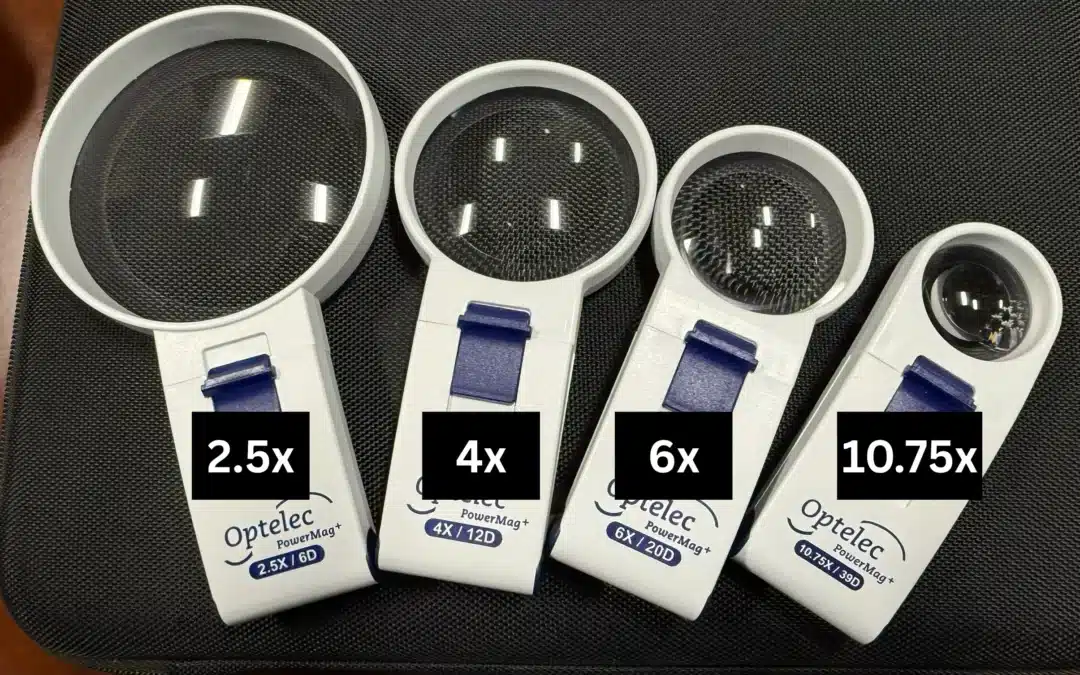
The main challenge with optical magnifiers arises when you need more magnification. There is a direct relationship between the power of the lens and its physical size. To increase magnification, the curvature of the lens must be increased. This physical law means that as the magnification power goes up, the diameter of the lens must come down.
Let’s compare a few strengths:
- A 2.5x magnifier has a relatively large lens.
- A 4x magnifier is noticeably smaller.
- A 6x magnifier is smaller still.
- A 10.75x magnifier has a very small diameter.

This reduction in size creates a significant problem. With a high-power magnifier, you are only able to see a very small area at a time—perhaps just a few letters. This makes it difficult to piece words and sentences together, which can slow down reading and lead to frustration.
How Central Vision Loss Affects Magnifier Choice
Conditions that cause central vision loss, such as macular degeneration, add another layer of complexity. Macular degeneration often creates scotomas, which are blind spots or defects directly in your central field of vision. This is the very part of your vision you rely on for detailed tasks like reading.
When you try to use a small, high-powered optical magnifier, you are attempting to look through the damaged center of your vision at a tiny, magnified area. The scotoma can easily block the letters you are trying to see, making the magnifier ineffective. If you find that you regularly need magnification of 10x or more, an optical magnifier is likely to cause more frustration than assistance. While optical magnifiers can be handy for on-the-spot reading, extensive use would be challenging and would most likely cause eye fatigue. At this point, it is time to consider an electronic or video magnifier.
The Advantages of Electronic Magnifiers
Electronic magnifiers, also known as video magnifiers, offer a technological solution that overcomes the physical limitations of optical lenses. A device like the Luna 6 serves as a great example. While it may have a handle similar to a traditional magnifier, its capabilities are far more advanced.
The key difference is that electronic magnifiers use a camera and a screen, not a simple lens. This changes everything.
Adjustable Magnification
Unlike an optical magnifier with a fixed power, an electronic magnifier offers a range of magnification levels. For example, the Luna 6 can adjust from 3x all the way up to 19x magnification with the simple press of a button. This means you can use a lower power for a wider field of view when scanning a page and then zoom in for smaller text, all without changing devices. Most importantly, the screen size does not shrink as you increase the magnification.
Enhanced Contrast and Color Modes
Perhaps the most critical advantage of electronic magnifiers is the ability to control contrast. As we age, and particularly with conditions like macular degeneration, we lose contrast sensitivity. This makes it difficult to distinguish black text on a white page, or to read newspapers with grayish print.
An electronic magnifier can digitally enhance the contrast, creating a sharp, high-contrast image of black text on a pure white background. Even better, you can reverse the colors to display white text on a black background, which many people find more comfortable for their eyes. Other color combinations are often available to suit individual preferences. This level of contrast enhancement is simply not possible with an optical magnifier, even one with a light.
Making the Right Choice for You
We often hear from people who have ordered a high-power optical magnifier, such as a 10.75x, only to be disappointed by its tiny size. Understanding the physics is crucial: as optical magnification power increases, the lens curvature increases and the lens diameter decreases.
If your vision needs are modest, a high-quality, low-power optical magnifier may be an excellent and portable tool for you. However, if you require higher magnification, or if you struggle with contrast sensitivity, an electronic magnifier will likely provide a much better experience. These devices offer the adjustable power and contrast enhancement needed to make reading possible and even enjoyable again.
If you have any questions about which type of magnifier would be right for your vision needs, feel free to reach out to our team. We are here to help you find the best solution.
Last updated December 6, 2025.
Author Information
Reviewed by Stuart Flom.